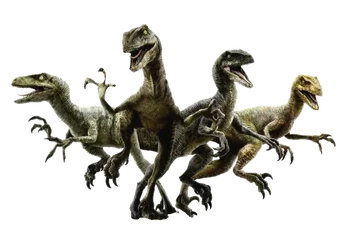
The Velociraptor is 3 to 5 meter long, 1.7 meter tall dromaeosaurid theropod carnivore that appears in all Jurassic Park films and film-based media.
Velociraptors are highly intelligent pack hunters. They could run 40-60 mph (65-100 km/h) at full sprint - fast enough to outrun many other dinosaurs. They have a primitive level of vocalization which enables them to direct attacks and call for help. They are also capable of setting traps for their prey.
Although it is called Velociraptor, it also shows characteristics of other dromaeosaurs, like Deinonychus and Utahraptor. A raptor in real life that vaguely resembles the dinosaurs in the film is the newly discovered Achillobator, a close Mongolian cousin to Utahraptor. In 2015 another discovery had born resemblance to Jurassic Park's Velociraptor, the North American dromaeosaurine, Dakotaraptor which was very close in size and shape to the animals featured in the films. Interestingly and by coincidence no less the Dakotaraptor was found in Montana, the same place where the film's Velociraptor was found. It is also noteworthy that Crichton's source material for Jurassic Park dinosaurs, Predatory Dinosaurs of the World, authored by Gregory S. Paul, used the name Velociraptor antirrhopus to describe Deinonychus antirrhopus, and this is believed to be why the Velociraptors are referred to as such. Michael Crichton also supposedly met with Gregory Paul several times during the writing process to consult about the accuracy and physical descriptions of the dinosaurs.
The Velociraptors in the films appear to resemble Deinonychus and are 6 ft tall (making them more similar in size to the larger Utahraptor) with their signature sickle claws being 6 inches. They had a resonation chamber located in their skull. According to Dr. Alan Grant, they were highly intelligent, being almost smarter than whales and even primates, which would make the film's Velociraptor the most intelligent dinosaur that would have existed as the intelligence of Troodon, the world's smartest dinosaur in real life, is comparable to the modern-day opossum. So far, multiple specimens of the film's Velociraptor have been found in the state of Montana in North America.
Dr. Grant theorized that a raptor pack would trap their prey. If potential prey saw a member of the pack it would freeze in place with the raptor would just looking back at them, as if in a standoff. Then the attack would come, not from the front, but from the flanks by other members of the pack.
Though it is popularly assumed that the film's Velociraptor is a reclassified Deinonychus (and out of universe the raptors were to be and were based on this dinosaur), the Holoscape attraction of the Jurassic World Innovation Center suggests otherwise with Velociraptor and Deinonychus being listed as entirely separate dinosaurs. Furthermore, when a little girl selected the Velociraptor hologram of the Holoscape, she selected the Velociraptor icon rather than the icon for Deinonychus. A dinosaur that in real-life resembles the film Velociraptor would be Dakotaraptor, a large raptor comparable in size that was said to have a skull similar to Deinonychus.
When they are born, they imprint on the first creature they come in contact with, even if this creature is not of their own species, and would be loyal to this individual. According to Jurassic Park game warden Robert Muldoon, the raptors were "lethal" at eight months of age. Muldoon also claimed that the raptors were able to reach speeds of 50-60 MPH in the open and were “astonishing jumpers”.