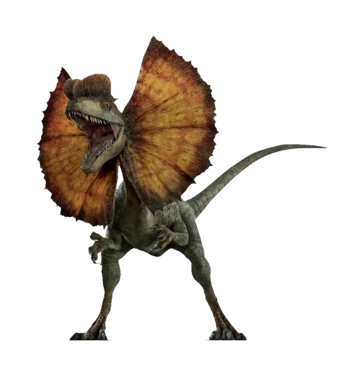
Dilophosaurus was one of the largest carnivorous dinosaurs of the Early Jurassic Period. Dilophosaurus gets its name from the two thin crests of bone on the top of its head. These were probably used as a display for courtship purposes. (Its frill and ability to spit venom at its prey is actually made up and no there is no proof if it had such abilities) Dilophosaurus has been found in Northern Arizona.
As a more primitive predatory dinosaur, Dilophosaurus didn't have forward facing eyes to give it stereo vision. It may have used scent as an integral part of its hunting technique. It had long and slender, rear-curving teeth in long jaws and strong front arms which would have been effective in grabbing prey. It was fast - probably with a top speed of about 30-mph. Footprints attributed to Dilophosaurus appear in groups, so it may have hunted in small packs. It shares the same overall body configuration as Coelophysis even though Dilophosaurus is currently classified as a member of a different group of theropods rather than Coelophysis and its relatives.
Seventeen Dilophosaurus were recreated by InGen in their compound on Isla Sorna where they were raised by the workers there until a few months had passed where five were transported to the neighboring island of Isla Nublar for InGen's Jurassic Park, though it is not entirely made clear whether they intended for them to spew venom or not, given the DNA they used to recreate them. They resided in the Dilophosaur Paddock of the park.
The cloned Dilophosaurus had very abnormal traits that the original never had. These traits include a frill, venom glands, and a skull that resembled dromaeosaurids like Deinonychus and InGen's recreation of Velociraptor.
Despite Dennis Nedry believing them to be harmless (a factor in his decision to allow them to be set free), the Dilophosaurus clones could spit venom at a range of 6 meters (20 feet) and would aim for their prey's face to stun it before the Dilophosaurus would come in for the kill. The frill would expand and rattle when attacking or when preparing to attack. They were also slightly smaller than their original counterpart, being 6 meters (20 feet) instead of 7 meters (23.25 feet) when fully grown, and lacked a fourth finger.
The cloned Dilophosaurus lacks a notch on the upper jaw. Like all of InGen's theropods, they had pronated wrists.
It's likely that Dr. Henry Wu's inclusion of frog DNA or a splicing error was responsible for the abnormal traits seen in the cloned Dilophosaurs. This is most likely possible, as Dr. Wu noted that Dilophosaurus genetic structure was compatible with the DNA of Dendrobates leucomelas (Yellow-banded poison dart frog).