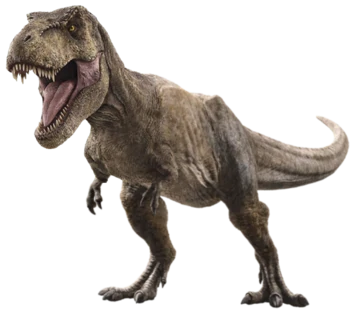
Tyrannosaurus (meaning "tyrant lizard") is an extinct genus of large theropod dinosaur. The species Tyrannosaurus rex (rex meaning "king" in Latin), often called T. rex or colloquially T-Rex, is one of the best represented members of the genus as well as all theropods. Tyrannosaurus lived throughout what is now western North America, on what was then an island continent known as Laramidia. Tyrannosaurus had a much wider range than other tyrannosaurids. Fossils are found in a variety of rock formations dating to the Maastrichtian age of the Upper Cretaceous period, 68-66 million years ago. It was the last known member of the tyrannosaurids and among the last non-avian dinosaurs to exist before the Cretaceous–Paleogene extinction event.
Like other tyrannosaurids, Tyrannosaurus was a bipedal carnivore with a massive skull balanced by a long, heavy tail. Relative to its large and powerful hind limbs, the forelimbs of Tyrannosaurus were short but unusually powerful for their size, and they had 2 clawed digits. The most complete specimen measures up to 12.3-12.4 meters (40.4-40.7 feet) in length and stands 3.66 meters (12 feet) tall, though T. rex could grow to lengths of around 13.2 meters (43.30 feet), up to 3.96 meters (13 feet) tall at the hips, and according to most modern estimates 8.4 metric tons (9.3 short tons) to 14 metric tons (15.4 short tons) in weight. Although other theropods rivaled or exceeded Tyrannosaurus rex in size, it is still among the largest known land predators and is estimated to have exerted the strongest bite force among all terrestrial animals. By far the largest carnivore in its environment and the infamous "king of the dinosaurs", Tyrannosaurus rex was most likely an apex predator, preying upon hadrosaurs, juvenile armored herbivores like ceratopsians and ankylosaurs, and possibly sauropods. Some experts have suggested the dinosaur was primarily a scavenger. The question of whether Tyrannosaurus was an apex predator or a pure scavenger was among the longest debates in paleontology. Most paleontologists today accept that Tyrannosaurus was both an active predator and a scavenger.
As the archetypal theropod, Tyrannosaurus has been one of the best-known dinosaurs since the early 20th century and has been featured in film, advertising, postal stamps, and many other media.
Specimens of Tyrannosaurus rex include some that are nearly complete skeletons. Soft tissue and proteins have been reported in at least one of these specimens. The abundance of fossil material has allowed significant research into many aspects of its biology, including its life history and biomechanics. The feeding habits, physiology, and potential speed of Tyrannosaurus rex are a few subjects of debate. Its taxonomy is also controversial, as some scientists consider Tarbosaurus bataar from Asia to be a 2nd Tyrannosaurus species, while others maintain Tarbosaurus is a separate genus. Several other genera of North American tyrannosaurids have also been synonymized with Tyrannosaurus.
During the Late Cretaceous period, a feathered Tyrannosaurus fought a Giganotosaurus, but was swiftly killed in the battle. Immediately after its death, a mosquito fed off the body's blood, which would later be used in InGen's cloning of the species.
Seven Tyrannosaurus rex were cloned by InGen scientists in their compound on Isla Sorna, circa 1990. One Tyrannosaurus, according to JurassicWorld.com, had lived on Isla Nublar for over 25 years, born in 1988. This means that it would have been 5 years of age at the time of the Jurassic Park Incident.
Unlike the originals, the T. rex clones have been known to see only movement due to the mixture of frog DNA. Like all of InGen's theropods, the T. rex clones have pronated wrists, although this was modified slightly for Jurassic World: Dominion. These clones run between 25 and 32 miles per hour.