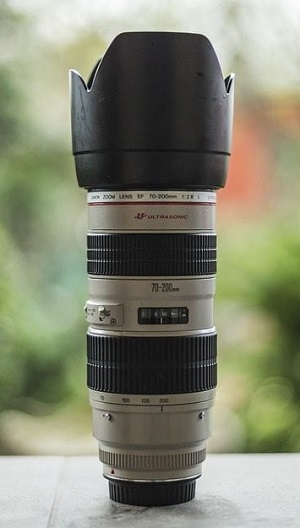
Telephoto lenses are sometimes broken into the further sub-types of short telephoto (85–135 mm in 35 mm film format), medium telephoto: (135–300 mm in 35 mm film format) and super telephoto (over 300 mm in 35 mm film format)
In contrast to a telephoto lens, for any given focal length a simple lens of non-telephoto design is constructed from one lens (which can, to minimize aberrations, consist of several elements to form an achromatic lens). To focus on an object at infinity, the distance from this single lens to focal plane of the camera (where the sensor or film is respectively) has to be adjusted to this focal length. For example, given a focal length of 500 mm, the distance between lens and focal plane is 500 mm. The farther the focal length is increased, the more the physical length of such a simple lens makes it unwieldy. But such simple lenses are not telephoto lenses, no matter how extreme the focal length – they are known as long-focus lenses.
While the optical centre of a simple ("non-telephoto") lens is within the construction, the telephoto lens moves the optical centre in front of the construction. While the length of a long-focus lens approximates its focal length, a telephoto lens manages to be shorter than its focal length. E.g., a telephoto lens might have a focal length of 400 mm, while it is shorter than that.
A telephoto lens works by having the outermost (i.e. light gathering) element of a much shorter focal length than the equivalent long-focus lens and then incorporating a second set of elements close to the film or sensor plane that extend the cone of light so that it appears to have come from a lens of much greater focal length. The basic construction of a telephoto lens consists of front lens elements that, as a group, have a positive focus. The focal length of this group is shorter than the effective focal length of the lens. The converging rays from this group are intercepted by the rear lens group, sometimes called the "telephoto group," which has a negative focus. The simplest telephoto designs could consist of one element in each group, but in practice, more than one element is used in each group to correct for various aberrations. The combination of these two groups produces a lens assembly that is physically shorter than a long-focus lens producing the same image size.